Building the Future of Sport: Danny Townsend on Leadership, Investment and Vision

Danny Townsend
 Text by: Marina Slobodyanik
From the beaches of Sydney to the boardrooms of global sport, Danny Townsend has built a career defined by ambition, reinvention, and strategic foresight. A former professional footballer turned entrepreneur and industry leader, Townsend now serves as CEO of SURJ Sports Investment, where he is helping shape Saudi Arabia’s rapidly evolving sports ecosystem while influencing the global sports economy.
In this conversation with Global Networker Magazine, he reflects on competition, leadership, investment with purpose, and the personal rhythms that sustain life at the top.
You began your career as a professional footballer before moving into executive leadership. How did your early experiences on the field shape the way you lead today?
There are many parallels between professional sport and executive leadership. The work ethic, discipline, and dedication required to succeed at the elite level are the same attributes needed in business. Transferring those fundamentals into the corporate world gave me a strong baseline, which I then complemented with subject-matter expertise over time.
Retiring at just 23 could have been a setback for many. What inner drive or perspective helped you pivot so successfully into business and leadership?
I’ve always been highly competitive in everything I do. When I could no longer channel that competitive energy into football, I redirected it into my business career. Building an agency in Australia with global ambitions meant competing against established players, winning clients, and proving credibility. That focus on winning became a critical ingredient in our success.
As the co-founder of Repucom, you transformed a start-up into a global sports intelligence powerhouse later acquired by Nielsen. What was your vision for data’s role in sports when few others saw its potential?
In the 1990s, sport was experiencing an early boom in sponsorship, but marketing budgets were becoming increasingly accountable and measurable. We saw a clear gap: sport lacked the same level of measurement available in other marketing channels. It was a necessity-driven insight. As brand clients began scrutinising spend more closely, sport risked losing relevance unless it could demonstrate value. Without measurement, investment would inevitably shift to more transparent channels like media advertising.
You’ve worked across Sydney, Singapore, London, and New York. How did these cities influence your understanding of sports as both a cultural and commercial phenomenon?
I’ve been fortunate to live and work in all those cities, and now Riyadh is adding another important chapter. While each market is culturally distinct, the fundamentals of sport remain remarkably consistent. The sports themselves may differ, but the way fans connect emotionally and commercially with sport is largely universal.
At SURJ Sports Investment, you’re now shaping Saudi Arabia’s global sports vision. What excites you most about building an ecosystem rather than just a portfolio of assets?
It’s incredibly exciting to help shape an entire sporting economy. Having spent most of my career in mature sports markets, the opportunity to influence the direction of Saudi Arabia’s sports sector is unique. What adds further scale is the ambition and capacity to influence the global sports economy at the same time. We’re not simply acquiring assets for financial return — we’re investing with a long-term view on how those assets contribute to the growth of sport in the Kingdom and globally.
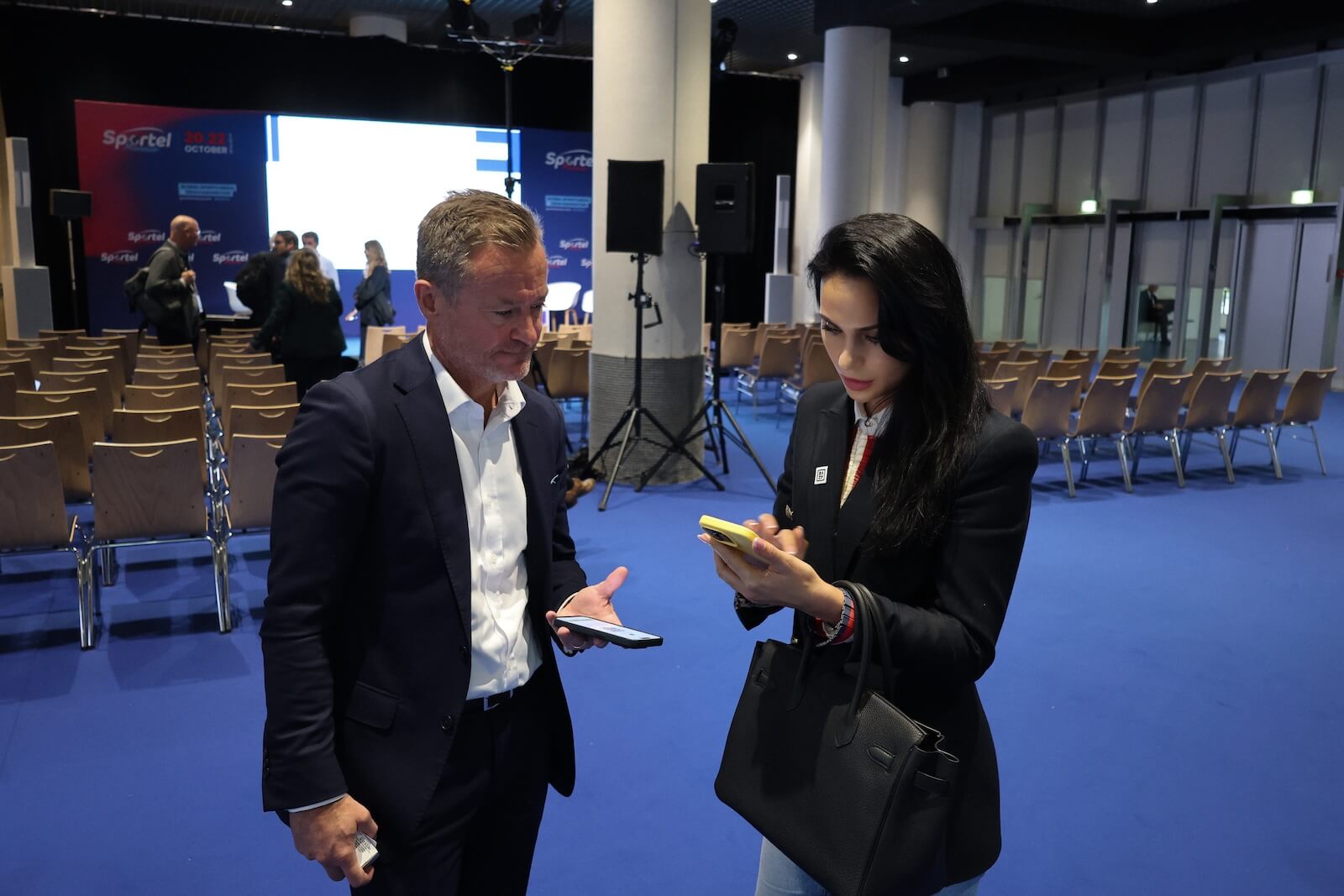
Danny Townsend and Marina Slobodyanik
What does a “smart investment” in sports look like to you today — and how do you balance financial return with cultural and community impact?
At our core, we are a sports investment company, so return on capital will always be paramount. However, our mandate requires creative thinking about how assets can also deliver broader cultural and social outcomes.
A smart investment delivers strong financial returns for SURJ while also creating meaningful domestic impact — particularly around participation, wellbeing, and community engagement.
Whether in football clubs or boardrooms, success depends on talent. How do you identify and nurture high-performance people within your organizations?
Talent identification and retention is arguably the hardest part of leadership. Young talent, in particular, is ambitious and impatient — which makes it both exciting and risky. At Repucom, we used to say to graduates: give us three years, and if we can’t find you a growth path internally, we’ll help you land a better role with a client. Seeing Repucom alumni now in senior roles at organisations like FIFA, the NBA, the English Premier League, and Formula 1 is one of the most rewarding aspects of my career.
How do emerging technologies like AI, data analytics, and immersive fan experiences fit into SURJ’s long-term vision for the global sports landscape?
The economics of sport are evolving rapidly. Traditional reliance on linear broadcast revenue is shifting, and digital and data-driven solutions are now critical. Building direct-to-consumer relationships with fans — and monetising those relationships effectively — will be essential for the financial sustainability of sport moving forward.
Your career has evolved through several chapters — athlete, entrepreneur, CEO. How do you personally recognize when it’s time to move on to the next challenge?
You tend to know when you can add greater value elsewhere and when you’ve taken a project as far as you can. In my experience, that moment of clarity usually arrives naturally.

Danny Townsend
What does “balance” mean to you in a world that’s always connected and in motion?
Balance is what you make of it. I wouldn’t say my life is perfectly balanced — but that suits me. What matters most is time with family. Being present when it truly counts is the hardest part of senior leadership, and something I remain very conscious of.
When you’re not leading global initiatives, how do you recharge or find inspiration outside of work?
I love the ocean. When I’m back in Sydney, surfing is my reset — it gives me space to think and, just as importantly, to switch off. Surfing with my two daughters is one of life’s greatest pleasures. Watching your children grow is a constant source of inspiration.
Looking ahead, how do you hope your leadership at SURJ will shape not only the company but the future narrative of global sport?
We’re still early in a long-term journey for SURJ and for the Saudi sports sector more broadly. Over time, I hope SURJ plays a pivotal role in shaping the industry both in the Kingdom and globally. I also want our portfolio companies to use our capital and expertise to meaningfully transform their sports and unlock the next phase of growth.