POLAND ON THE BRINK OF A CONSTITUTIONAL CRISIS: TUSK AND NAWROCKI ENTER AN OPEN POWER STRUGGLE
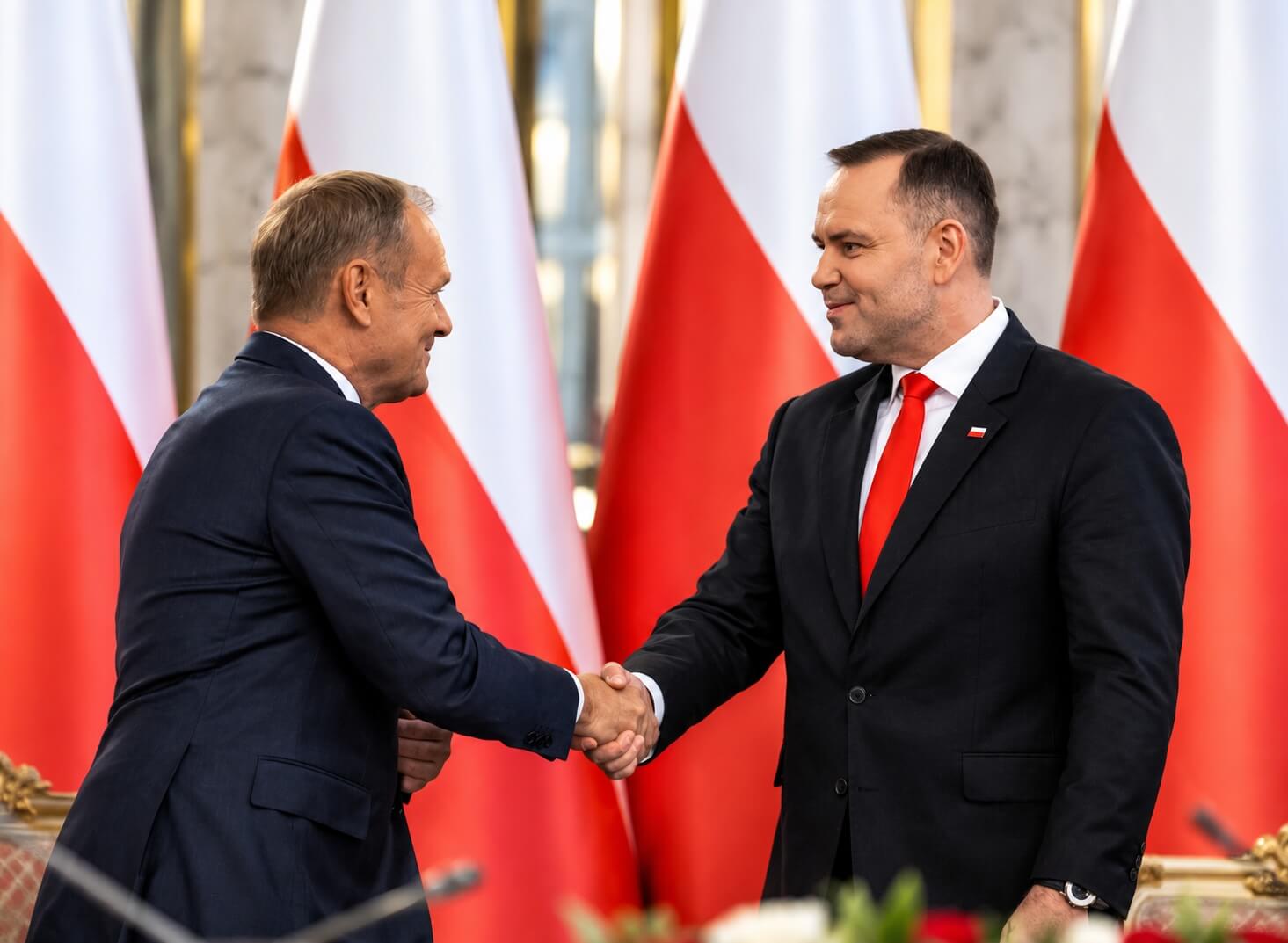
Donald Tusk, Prime Minister of Poland, and Karol Nawrocki, President of Poland.
The confrontation between Prime Minister Donald Tusk and President Karol Nawrocki has escalated into one of the most serious institutional conflicts in modern Polish history. At the centre of the dispute stands the Constitutional Tribunal, while behind the legal battles lies an increasingly fundamental question: who sets the rules of the political game in one of the European Union’s largest member states?
Poland, long regarded as one of the key pillars of political and economic stability in Central Europe, is facing a serious test of its institutional resilience. The events of October 30, 2026, surrounding the Constitutional Tribunal demonstrated just how deeply the confrontation between Prime Minister Donald Tusk and President Karol Nawrocki has intensified. Following reports of a disputed change in the leadership of the country’s highest constitutional review body, police units appeared in Warsaw, opposition representatives raised allegations of violations of the constitutional order, and the president, who had been travelling to Senegal, interrupted his international trip and returned to the Polish capital. A political conflict that had unfolded for years primarily within parliamentary chambers, judicial institutions, and public statements has now evolved into an open institutional confrontation.
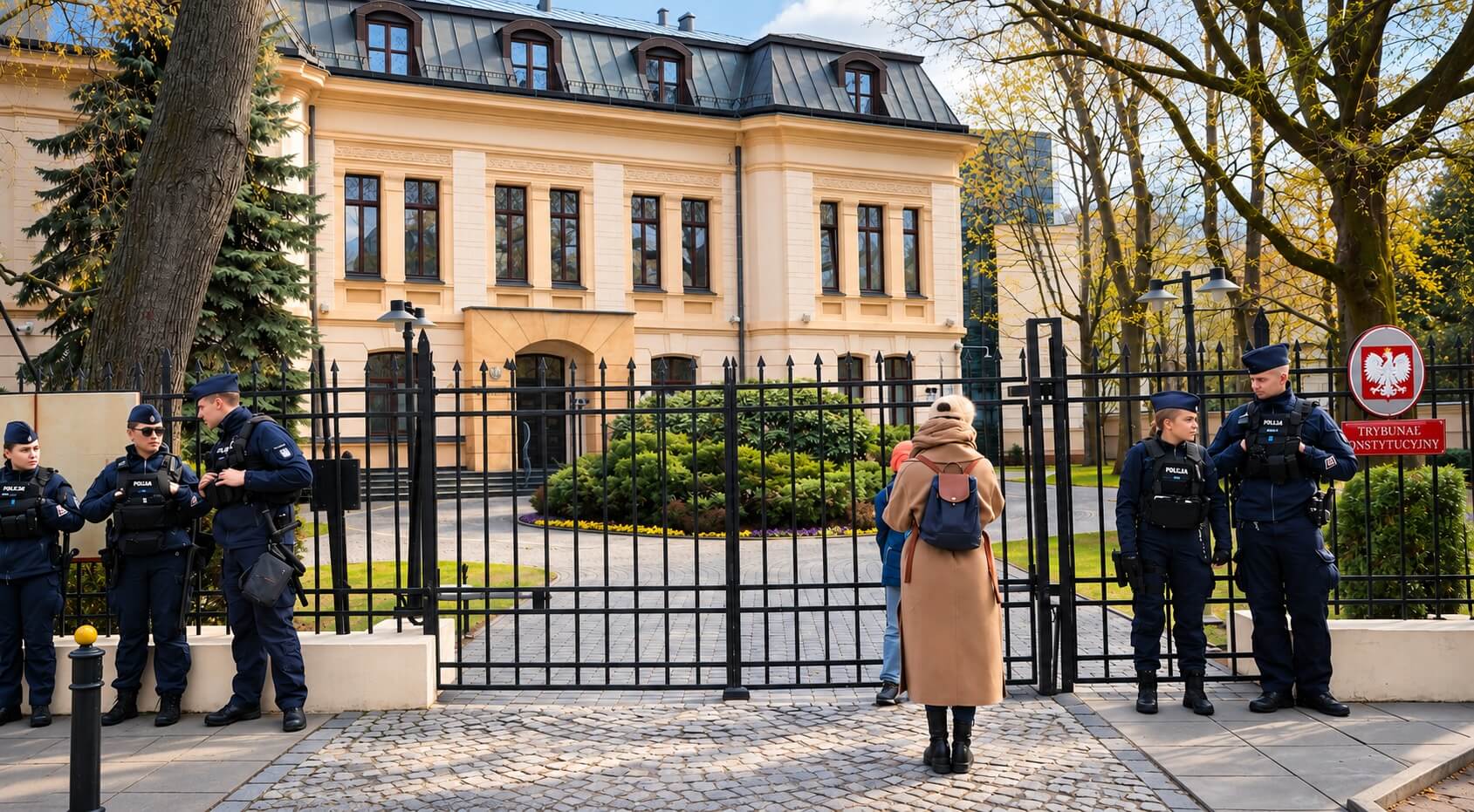
At the heart of the crisis is the Constitutional Tribunal, the institution responsible for ensuring that legislation complies with the country’s Constitution. According to reports concerning the events of October 30, Judge Anna Korwin-Piotrowska announced the temporary suspension of the Tribunal’s president, Bogdan Święczkowski, and his deputy, Bartłomiej Sochański, declaring that she was assuming leadership responsibilities. However, the legality of this decision immediately became the subject of intense controversy. Representatives of the previous leadership and the opposition Law and Justice party (PiS) questioned its legal basis, while supporters of judicial reform viewed the developments within the broader context of longstanding efforts to restore the independence of Poland’s judiciary. The presence of police officers outside the Tribunal and the political mobilisation surrounding the institution transformed a legal dispute into an event of national significance. At the same time, allegations of an attempted coup, voiced by political opponents of the government, remain political accusations rather than legally established facts.
The origins of the current confrontation extend far beyond the events of recent days. Following its rise to power in 2015, the conservative Law and Justice party initiated extensive changes to the judicial system, including reforms to judicial appointment procedures and the functioning of the Constitutional Tribunal. These measures drew significant criticism from European institutions, which expressed concerns about the potential erosion of judicial independence. When Donald Tusk took office as head of a new governing coalition in 2023, restoring the rule of law became one of the central priorities of his political agenda. However, attempts to reverse decisions made by the previous administration encountered legal constraints and resistance from political opponents. As a result, Poland found itself in a situation in which competing centres of power not only advocate fundamentally different approaches to judicial reform but also challenge the legitimacy of certain state decisions.
The election of Karol Nawrocki as president in 2025 further intensified this confrontation. Having secured the support of conservative voters and the Law and Justice party, the new head of state emerged as a significant political counterweight to Tusk’s government. Poland’s constitutional framework establishes a division of powers between the president and the cabinet while simultaneously requiring cooperation between the two institutions on a wide range of issues.
The president holds the power to veto legislation, participates in certain official appointments, and performs important functions in national security and international representation. Under conditions of political consensus, this system helps maintain institutional balance. However, in an environment of deep polarisation, it can become a mechanism through which competing branches of government obstruct one another’s decisions. This is precisely the situation currently unfolding in Warsaw, where the president and prime minister effectively represent competing political visions for Poland’s future.
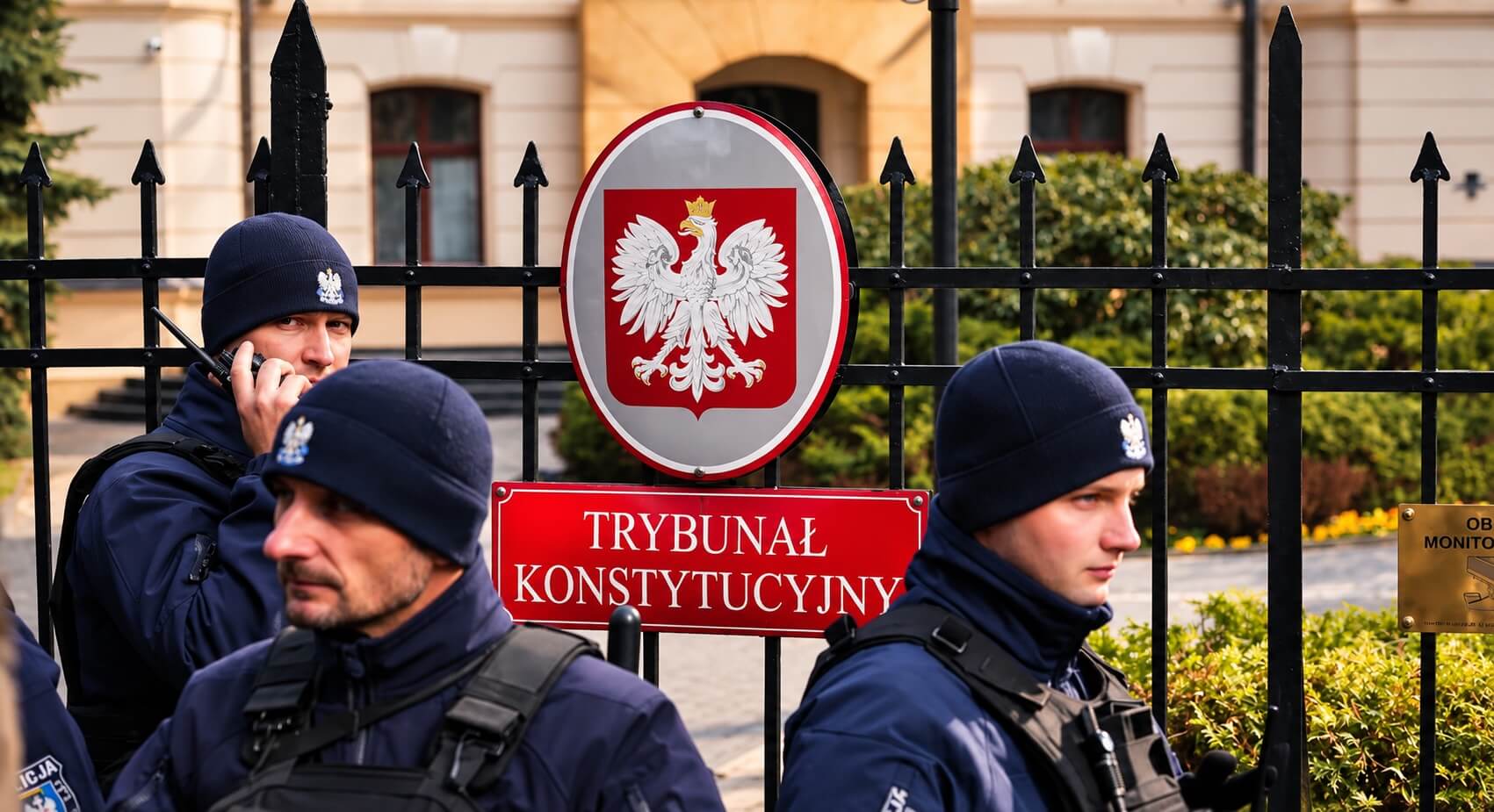
Polish police officers outside the Constitutional Tribunal in Warsaw. Judicial reform has become one of the main sources of political confrontation between Prime Minister Donald Tusk and President Karol Nawrocki.
For Donald Tusk, the current developments represent a continuation of his efforts to restore judicial independence following eight years of conservative rule. His government argues that a democratic state cannot function effectively if key judicial institutions continue to reflect the consequences of politically motivated appointments and procedural violations. For Karol Nawrocki, however, the situation appears fundamentally different. The presidential camp insists that correcting alleged violations committed in the past cannot be achieved through methods that themselves raise constitutional concerns. Both sides therefore invoke the principle of the rule of law, yet they fundamentally disagree on which actions genuinely uphold that principle. This is where the central paradox of Poland’s constitutional crisis emerges: political forces publicly committed to defending judicial independence accuse one another of attempting to establish political control over the judiciary.
The international significance of the crisis is heightened by Poland’s strategic position. The country is one of the European Union’s largest economies, a crucial logistics hub in Central Europe, and a key participant in the continent’s security architecture. For international businesses, political stability is determined not only by economic growth but also by legislative predictability, the effectiveness of the judicial system, and the ability of state institutions to enforce decisions. A prolonged confrontation between the president, government, and judiciary could increase legal uncertainty, complicate reform efforts, and elevate political risks. This does not automatically imply a deterioration in the investment climate, but it raises additional questions for companies considering Poland as a long-term destination for capital investment, manufacturing operations, and European expansion.
The European dimension of the crisis is equally important. For years, Brussels has closely monitored developments within Poland’s judicial system, regarding judicial independence as one of the fundamental principles of European Union membership. Donald Tusk’s return to power was initially viewed as an opportunity to normalise Warsaw’s relations with European institutions and bring longstanding disputes over the rule of law to an end. However, recent events demonstrate that a change of government does not automatically resolve deeply rooted institutional contradictions. Moreover, efforts to restore public confidence in the judiciary may prove far more politically and legally complex than initially anticipated. For the European Union, this creates a delicate situation: while supporting the independence of judicial institutions, European authorities must also assess compliance with lawful procedures regardless of which political force holds power.
The domestic political consequences of the confrontation could be equally significant. Poland is approaching its 2027 parliamentary elections, and the dispute surrounding the Constitutional Tribunal could become one of the defining issues of the upcoming campaign. For Tusk’s supporters, judicial reform remains a symbol of the restoration of democratic standards, while for the conservative opposition, the government’s actions provide arguments for limiting the governing coalition’s authority. In an environment of intense political polarisation, each new institutional confrontation risks reinforcing existing electoral divisions.
Meanwhile, public confidence in the judicial system may become one of the principal casualties of a prolonged conflict, as citizens increasingly struggle to perceive state institutions as independent from political competition.
The events of October 30–31 have once again demonstrated that Poland’s constitutional crisis has long since moved beyond a purely legal dispute over judicial appointment procedures. Today, the issue concerns the ability of the state to function when its principal political actors operate according to conflicting interpretations of constitutional legitimacy. For Donald Tusk, this represents a test of his government’s ability to implement its promised reforms. For Karol Nawrocki, it is a test of the presidency’s capacity to serve as an institutional counterweight to the government. For Poland as a whole, however, the stakes extend far beyond the personal rivalry between two political leaders. The manner in which the current confrontation is resolved will shape not only the future distribution of political power but also public confidence in the very principle of independent state institutions. Ultimately, the resilience of a democracy is measured not by the absence of political conflict, but by its ability to resolve such conflicts through widely recognised legal and constitutional procedures. It is precisely this test that Poland is facing today.
GLOBAL NETWORKER | POLITICS & BUSINESS